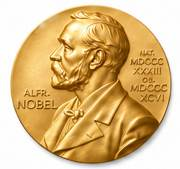
Nobel Foundations of Oxygen, Metabolism & Physiology
A century of Nobel-recognized discoveries transformed our understanding of oxygen delivery, physiology, cellular metabolism, hypoxia and adaptation.
A CENTURY OF DISCOVERIES
1920Capillary Circulation & Oxygen Delivery⌃
Capillary Circulation & Oxygen Delivery
The Discovery
Krogh was awarded the Nobel Prize for discovery of the capillary motor regulating mechanism. His work established fundamental principles of how the microcirculation regulates blood supply to active tissues.
Scientific Significance
Oxygen content in blood alone does not determine tissue oxygenation. Blood must reach metabolically active tissue through an appropriately regulated microcirculation. This established microvascular flow as a core determinant of tissue oxygen supply.
Why This Matters to Us
Oxygen-carrying capacity and oxygen delivery are not the same thing. Effective oxygenation depends on oxygen content, blood flow, microcirculatory distribution and tissue demand. This distinction is central to Precision Oxygenation Therapeutics.
1922Muscle Energetics, Oxygen Consumption & Metabolism⌃
Muscle Energetics, Oxygen Consumption & Metabolism
The Discovery
Hill was recognized for discoveries relating to heat production in muscle, while Meyerhof was recognized for the relationship between oxygen consumption and lactic-acid metabolism in muscle.
Scientific Significance
The work connected oxygen consumption with changing metabolic activity and energy demand, helping define the physiological relationship between oxygen use and muscular energy processes.
Why This Matters to Us
Oxygen demand is dynamic. A functional oxygen-delivery strategy must consider whether oxygen supply matches the metabolic requirement of the tissue at that moment, not oxygen content alone.
1923Insulin, Diabetes & Metabolic Regulation⌃
Insulin, Diabetes & Metabolic Regulation
The Discovery
The discovery of insulin transformed diabetes treatment and established a central mechanism in physiological regulation of glucose metabolism.
Scientific Significance
It demonstrated the importance of regulated metabolic substrate availability and helped define modern endocrine and metabolic physiology, linking systemic regulation with cellular energy requirements.
Why This Matters to Us
Diabetes is included here as metabolic context, not as evidence that BHOC treats diabetes. Of interest is the interaction among metabolic demand, vascular function, microcirculation and oxygen availability in tissue physiology.
1931Cellular Respiration & Oxygen Utilization⌃
Cellular Respiration & Oxygen Utilization
The Discovery
Warburg received the prize for discovery of the nature and mode of action of the respiratory enzyme, advancing understanding of cellular respiration and oxygen utilization.
Scientific Significance
The work moved oxygen science beyond transport toward the biochemical processes through which living cells use oxygen, making cellular utilization a distinct part of oxygen physiology.
Why This Matters to Us
Delivery is not the biological endpoint. Oxygen must become available to cells and participate in respiratory metabolism. Warburg's broader work also became foundational to later investigation of altered metabolism in cancer.
1953Cellular Energy Metabolism⌃
Cellular Energy Metabolism
The Discovery
Krebs was recognized for discovery of the citric acid cycle and Lipmann for coenzyme A and its importance for intermediary metabolism.
Scientific Significance
These discoveries established core biochemical pathways linking nutrients, cellular energy production and intermediary metabolism and helped explain how metabolic substrates are converted into usable cellular energy.
Why This Matters to Us
Oxygen physiology cannot be separated from cellular energy metabolism. Tissue oxygen requirements vary with metabolic state, organ function and physiological stress, making metabolic demand part of the oxygen-delivery equation.
1998Vascular Physiology & Nitric Oxide⌃
Vascular Physiology & Nitric Oxide
The Discovery
The prize recognized nitric oxide as a signaling molecule in the cardiovascular system, establishing a new biological principle for communication and regulation within the vasculature.
Scientific Significance
NO became central to understanding vascular tone, blood pressure and regulation of regional blood flow, showing that tissue perfusion is actively controlled by molecular signaling.
Why This Matters to Us
More oxygen-carrying capacity does not automatically mean more oxygen reaches tissue. Vascular tone, nitric-oxide biology, microcirculatory flow and regional perfusion are integral to functional oxygen delivery and are particularly relevant when evaluating cell-free hemoglobin oxygen carriers.
2019Oxygen Sensing, HIF & Hypoxia⌃
Oxygen Sensing, HIF & Hypoxia
The Discovery
The laureates revealed molecular mechanisms that allow cells to sense changing oxygen availability and regulate gene activity in response, defining a fundamental oxygen-sensing system.
Scientific Significance
The HIF pathway links oxygen availability with adaptive gene regulation, metabolism, erythropoiesis, angiogenesis and broader physiological responses to hypoxia.
Why This Matters to Us
This provides a critical conceptual bridge from oxygen transport to biological response. Oxygen is not merely carried to tissue; it is delivered, sensed and utilized. Tissue oxygen availability therefore has biological meaning beyond blood volume or hemoglobin concentration alone.